
The problem in everyday life
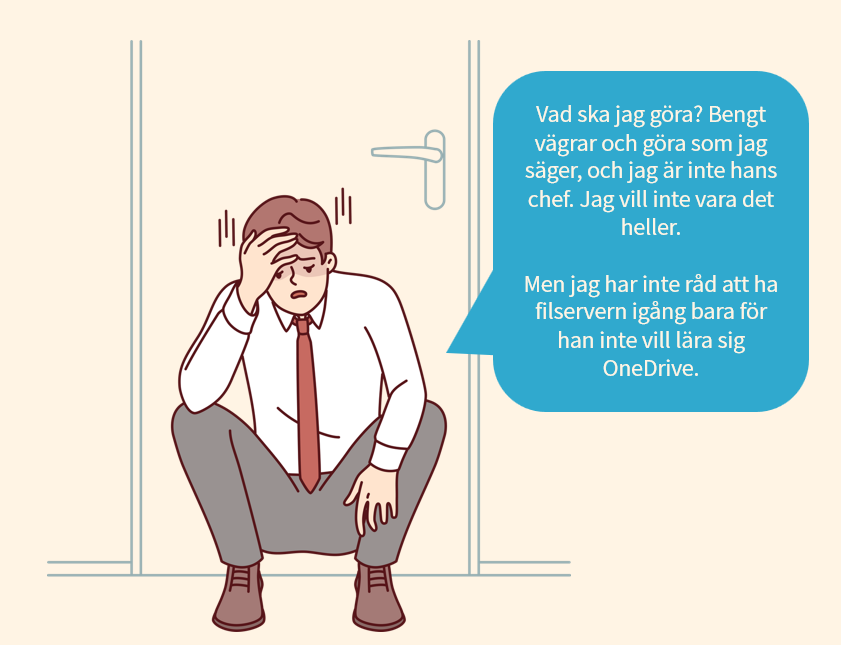
We should have a modern, agile IT environment. IT is of course responsible for it. But when something goes wrong, everything is dumped on IT. Onboarding lacking content? “IT, fix it.” Customers aren't getting their receipts because the policy is stopping the flow? “IT, change.” “Give CFO access now.” “We have to have Zoom – period.” And then Bengt who refuses to leave the file server and intends to scream all the way to Q4. IT owns the platforms – but has to bear other people's decisions, emotional buying and missing processes.
The result is the usual: fire department calls, back doors to management, duplicate tools, and a daily routine where IT becomes the police instead of a partner.
Why is it difficult?
- The concepts are mixed up. IT owns the platform (technology, operation, configuration). The business owns workplace (process, content, behaviors). When we mix it up, responsibility slips – straight to IT.
- Responsibility is slipping. Problems that are actually owned by HR/Finance/Legal/Communications end up in IT “because there is a button”.
- Policy clashes with process. The technology does the right thing – but the way of working is never designed according to the policy (the receipt, the agreement, the access...).
- Shortcuts & emotional buying. “We have to have Zoom” → costs, standards and rooms are disappearing – without anyone having decided the whole thing.
- Change ≠ automagic. “Close the file server” without support and time will only become a conflict with Bengt, not a change.
The way forward – governance sets the rules of the game
- Ownership & roadmap are decided in the governance group. The business is represented and responsibilities are clear. We prioritize for a well-oiled machine – not to silence naysayers.
- The management points out the direction. Principles and priorities so everyone knows what applies when technology meets reality.
- Decisions are made in the room – not in the hallway. The governance group brings together IT, HR, Communications, Legal and information owners and makes trade-offs: “yes, if…” instead of locked no's or free passes.
- Simple intake. No rear doors. New tools, exceptions, access and integrations go through the governance group. Benefit, risk and cost are assessed – decisions and justifications are published.
- Ownership in everyday life (without dumping). IT delivers the platform and permissions; HR is responsible for the onboarding content; Finance for receipt flows; managers/information owners decide on access.
- Build in pace. Information security first – then policy → training → structure → automation. No AI features on top of manual mess.
When the foundation is laid
IT becomes a partner – not a “department of no”. They receive clear orders with the right documentation, accepted risks and decided exceptions – and own the platform responsibility: configure, secure and deliver. Exceptions and conflicts go through the governance group instead of becoming internal battles. Employees get a consistent way of working – and Bengt works in OneDrive, or there is a timed, decided exception.
This post is part of the series Common mistakes in the digital workplace.